Category Archives: Research

Talk on the Politics of Sustainability for CTI

The Charlotte Teachers Initiative (CTI) is an initiative focused on strengthening teaching in the Charlotte area.  It hosts a wide range of seminars for teachers led by college professors in the region as well as special events on particular topics for both teachers and the public.  I was invited to speak at one of these events in October on “Exploding Canons: Sustainability in Charlotte and Beyond.”  It was preceded by a reception and information expo with tables from dozens of sustainability and education related organizations from the area, and moderated by Rob Phocus, energy and sustainability manager for the City of Charlotte.

I was one of several speakers from Davidson College, UNC Charlotte, Wake Forest University, and two Mecklenburg public schools, and started off the event with a presentation on the “Politics of Sustainability.”  I talked about the transition from “government to governance” in the context of environmental issues, and the idea of multi-scale polycentric governance that Eleanor Ostrom and others have described as the current reality of sustainability politics.  I used two case studies from my own professional experiences to explore the challenges of sustainability issues – one from my work in China with the Nature Conservancy and one from my work as a Co-Founder of GoodGuide.
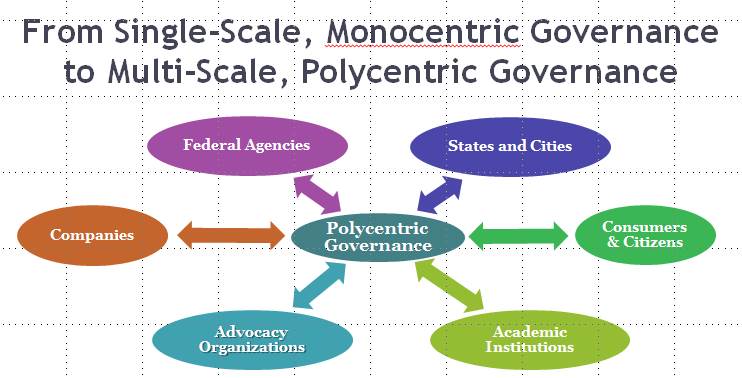
governance graphicThe audience had some great follow-up questions and comments, and overall I thought the event went really well.  I particularly enjoyed meeting some of the teachers and faculty members who have participated in CTI, and learning about all of the organizations that are working on sustainability-related projects in the Charlotte region.

Faculty Series Presentation on “Policy and the Environment”

In September, I gave a presentation as part of Davidson College’s ongoing faculty series on “Policy and…”  Every month over the course of the semester, several faculty and staff members presented on different aspects of policy from the vantage point of their own research and professional work.  My topic was Policy and the Environment, and as the first speaker in the series, I first discussed what we mean by “policy,” tracing the words origins back to no less a source than Chaucer’s Canterbury Tales.

definition of governanceI then explored its use in the environmental context, and how environmental policy has evolved over the last several decades.  I concluded with a discussion of information-based governance and policy, such as the use of eco-labels and ratings to encourage pro-environment behavior, which has boomed in recent years and is the focus of my  research.

My presentation helped frame the next two presentations, which were focused more on local issues of environmental policy and the preservation of natural forests and habitat from destruction and development.  These faculty panels are great opportunities not only for students to learn more about what their professors are working on, but also for faculty to learn more about each other’s work.  I had some nice conversations with several of my colleagues after this and other similar events about various connections between our areas of interests and expertise.  This is one of the benefits of being at a liberal arts college – there is a real opportunity and possibility of engaging in substantive discussions and even collaborations with faculty from very diverse backgrounds who you would not likely ever even meet at a large university.

Environmental Politics and Presidential Elections

The day after the 2012 election, I had tDavidson Learns Logohe pleasure of leading a class of Davidson Learns, a new lifelong learning initiative serving the Lake Norman area, on environmental issues in Presidential elections.  The talk was entitled “Does the Earth Matter, and in it I took the audience on a whirlwind tour of presidential debates, which was fun because unlike my Davidson undergraduate students, most in the audience remembered these events very clearly.  We watched clips from debates between Bush, Clinton, and Perot, Clinton and Dole, Bush and Gore, and Bush and Kerry, and Obama and McCain, and looked at word clouds from these debates of terms relating to the environment.  We also discussed data and analyses of public opinion related to the environment and presidential candidates.

My thesis was that while environmental issues have never been the most important issue in a presidential campaign, 1) they have influenced some voter preferences and 2) they have been key components of campaign strategy in all of the presidential elections.  This is primarily due to their latent importance to the American electorate.  We had a lively and interesting discussion of these ideas – it was great to connect and talk about American politics and the environment with members of the broader Davidson community, and look forward to doing it again in the future.

Interviews on the Radio and the Web

photo of Graham Bullock Earlier this year, I participated in a panel discussion on A Healthier Charlotte, focusing on “Environmental Health in the Queen City,” with Dr. Jessica Braswell from Queens University.  Moderating the panel was a Davidson graduate, Bobby DeMuro, who has organized a great range of discussions on this web TV show, which is hosted on CLTBlog.com.   You can watch the episode here, which begins with a panel with two veterans of the Charlotte environmental scene, and then starts with our panel at 18:54 in the video.

In a separate interview later in the year, I also did a one-on-one interview with Mr. DeMuro, which had the more specific topic of “Climate Change in Charlotte.”  We covered some of the same topics, but also touched on some other ones as well in our 10 minute discussion.  You can access the interview at http://bobbydemuro.com/work/wbt/ — just click on my name under the March 18 show date, which will open to where you can download the mp3 of the interview.

It has been fun getting plugged in more to the Charlotte scene, and learning more about the health and environment issues the city is facing.  Charlotte has been growing rapidly in recent years, which has brought a lot of great benefits to the city, but that growth has also created some complex challenges, such as how to deal with increasing smog levels, decreasing air quality, and greater traffic congestion.  The city’s leaders are working hard to find smart and sustainable ways to tackle these challenges, and I hope that we see the benefits of these efforts in the months and years to come.

Association for Environmental Studies and Sciences (AESS)

Mission Santa ClaraIn June, I attended the Annual Meeting of the Association for Environmental Studies and Sciences (AESS) at Santa Clara University, which is right outside San Jose, CA.  I presented a paper on “Environmental Evaluations of Companies and Products: The Role of Academia,” which built on data from an online survey of over 400 individuals I conducted as part of my dissertation research.  Among those surveyed, academic institutions were the most preferred source of information about the product and corporate environmental performance  — more preferred than government, non-profit, media, and company sources.  And yet my coding of over 245 eco-label and rating initiatives indicate academic institutions are the least likely to be directly involved in the implementation and design of these programs.  I analyzed several examples of initiatives that are run by or closely associated with academic institutions, as a means to demonstrate the range of ways academics can be involved in these efforts.

We then discussed why academic researchers have had such limited involvement, whether they should be more involved (without losing their credibility and independence), and ways that might facilitate academics to becoming more engaged with these programs in the future.  While there are important pitfalls to avoid in doings, the strong preferences survey participants have for academic involvement suggest that they can very much improve the perceived quality and credibility of existing eco-labels and ratings.

The conference overall was fantastic, and I learned a lot from the diverse sessions that I attended.  Strongly recommended conference for people who research environmental issues, and especially those who teach in interdisciplinary environmental studies and sciences programs.

Responsible Consumption Working Group

researching products in the storeThis spring I worked with several students and staff in creating a “Responsible Consumption Working Group” on campus.  The idea of it was born out of a talk I gave last fall for an event students organized on “responsible consumption,” and there was enough interest in the concept that we decided to create this group to actually work on testing out and implementing the idea in our lives.

Our organizing question has been whether or not we can come up with innovative new strategies to make buying more environmentally and socially responsible products easier and more fun.  Some of the ideas we have been testing out have included picking out our own issues we want to research but then meeting monthly to compare notes, sharing our results with each other online, and deciding to research and make a decision on what to do about product category within a specified amount of time.  So far we’ve made some great progress, and our group was recently featured in the Davidson Journal, Davidson College’s alumni magazine (http://davidsonjournal.davidson.edu/?p=2385).  We plan to continue our work this fall — stay tuned and get in touch if you are interested in joining us!

Annual Meeting of the Society for the Social Studies of Science (4S)

Berkeley campus imageIn November, I attended and presented a paper at the Annual Meeting of the Society for the Social Studies of Science (4S) in Cleveland, OH.  The paper was titled “Quis Custodiet Ipsos Custodes? Expertise and Democracy in Eco-Label Accountability,” and looked at the role of several new initiative that have emerged to evaluate the effectiveness of eco-labels and sustainability ratings.  Rating the raters, or “guarding the guardians,” hence the reference to the famous phrase in Latin.  These different initiatives all attempt to employ different processes of science and technologies of participation to establish their legitimacy as such guardians, and I analyzed the approaches of two particular cases, the FTC and EnviroMedia.

The obvious question that arises is, who watches the watchers of the watchers?  There are two possible ways to end the infinite loop — one is competition and peer review (they watch each other) and the other is public transparency and accountability (we, the public, watch them).  Whether or these mechanisms are effective is a question for another day…

Eco-Labels Research Trip To Japan

Japan flagThis summer I took a short trip to Japan to conduct research on the status of Japanese environmental certifications and sustainability ratings.  In my future research, I am planning to compare the evolution of these strategies in different countries, and from my past research, I knew that Japan has developed some innovative but not widely known programs (such as EcoMark).  I was able to connect with some contacts I had made on a trip five years ago to the country, and made some new connections as well.  Government, non-profit, and corporate entities are all working on some interesting projects relating to labeling, and I am looking forward to applying some of the frameworks and analytical tools I developed in my past research to these programs in Japan.

University of Michigan Eco-Labels Conference

Erb Institute logoIn June, I attended a small conference on eco-labels at the University of Michigan, which was hosted for the second year by the Ross School of Business Erb Institute for Global Sustainable Enterprise (and jointly sponsored by the Sustainability Consortium).  I had attended the first conference in 2010, and it was great to see many of the same people, and compare notes on the state of eco-labels around the world.  This year’s theme was “Informing Green Markets: What Makes a Difference and Why,” and there was a fantastic range of presentations on supplier choices about certification, corporate level reputation ratings, social norms and labeling, consumer awareness, and designing better systems.

My own presentation was on “Green” Demand: Consumer Preferences for Different Types of Product Ecolabels and Corporate Sustainability Ratings,” and discussed the results of my online survey of over 500 consumers.  Overall, both academic researchers and practitioners from the private, government, and non-profit sectors attended the conference, which made for some engaging discussions among people who have thought a lot about the questions and issues that I have been grappling with and analyzing in my own research over the last several years.  I look forward to staying in touch with the other attendees, and keeping up on their work in the field.

Dissertation Submitted, PhD Complete!

certificate of completionOn May 13, I officially was notified by the Graduate Division of the University of California, Berkeley that I had completed all the requirements for the degree of Doctor of Philosophy!  I had submitted my dissertation several days before, after getting signatures from all four of my advisors — Kate O’Neill, Keith Gilless, David Levine, and David Vogel.  It was a long and arduous process, but in the end quite rewarding.  Thanks to everyone who helped me get through it!

Also below are a few more pictures from the College of Natural Resources’  Commencement Ceremony, which was held in Berkeley’s Greek Theater.  Very cool — you can see a couple of pictures from the big day below, including one of me about to be “hooded!”

I’ve also posted an abstract and executive summary of  my dissertation on this website — you can access them here.  If you’d like to see the entire dissertation, feel free to email me at gbullock7 at gmail.com and I’ll send you a copy.